Skip to content
AI Tools Directory · 3 min read

Beyond Chat: ChatGPT’s App Integrations Usher in a New Era of AI Productivity

Discover how ChatGPT app integrations with Spotify, Canva, and Expedia transform daily tasks. Unlock new AI productivity today!

Overview

The landscape of artificial intelligence is rapidly evolving, with large language models (LLMs) like ChatGPT moving beyond mere conversational interfaces to become powerful operational hubs. A significant leap in this evolution is the introduction of direct app integrations, allowing users to leverage the capabilities of popular third-party applications from within ChatGPT itself. Imagine planning a trip, designing a graphic, or curating music—all without leaving your AI assistant. This new functionality fundamentally redefines user interaction with digital tools.

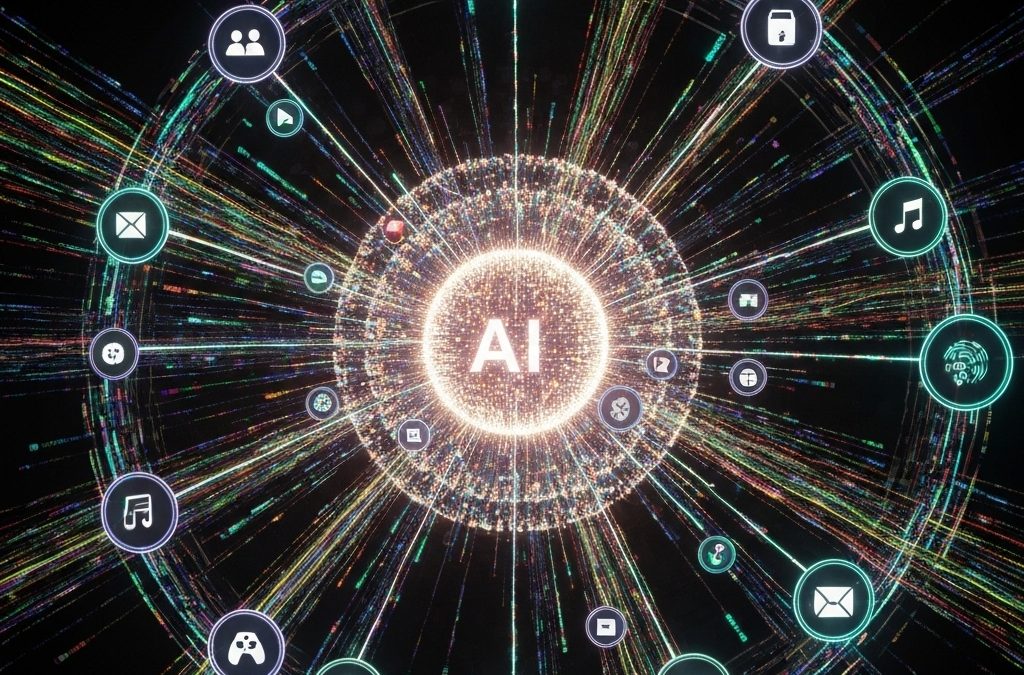
Previously, ChatGPT excelled at generating text, answering questions, and assisting with creative tasks. Now, it acts as an intelligent orchestrator, connecting users directly to services like Spotify for music, Canva for design, Figma for collaborative design, and Expedia for travel planning. This integration streamlines workflows, reduces context switching, and empowers users to accomplish complex multi-step tasks with unprecedented ease, simply by conversing with the AI. It’s a pivotal moment, transforming ChatGPT from a standalone AI companion into an indispensable, interconnected platform for daily digital life.

Impact on the AI Landscape

This move by ChatGPT represents more than just a feature update; it signals a profound shift in the AI landscape. By integrating external applications, ChatGPT is positioning itself as a foundational operating system or a universal interface for the digital world. This strategic expansion broadens the scope of LLMs, moving them beyond pure information processing to direct action execution. It fundamentally challenges traditional app ecosystems, suggesting a future where users primarily interact with a single AI interface that dispatches commands to specialized services behind the scenes.

The implications for developers are substantial, potentially fostering a new marketplace for AI-powered plugins and integrations. For users, it promises a more cohesive and intuitive digital experience, reducing the friction often associated with navigating multiple applications. This development also intensifies the competition among leading AI models, pushing others to develop similar integration capabilities to remain relevant. Ultimately, this paradigm shift elevates the role of AI from a helpful tool to an essential, interconnected orchestrator of our digital lives, pushing the boundaries of what conversational AI can achieve.

Practical Application

The real power of ChatGPT’s new app integrations lies in their practical, everyday utility, transforming how individuals approach tasks. For instance, a user planning a vacation no longer needs to jump between travel sites; they can simply tell ChatGPT, “Find me flights to Tokyo for next March on Expedia,” and the AI will initiate the search and present options. Similarly, a marketer could command, “Create a social media banner for our new product launch using Canva,” and ChatGPT would facilitate the design process, potentially even suggesting initial layouts or content.

Music enthusiasts can simply say, “Play my ‘morning commute’ playlist on Spotify,” directly controlling their audio experience. The convenience extends to professional workflows as well, with designers potentially using Figma integrations to fetch design elements or collaborate on projects through natural language prompts. This seamless interaction removes the need to open, navigate, and learn the specifics of numerous individual applications. It dramatically reduces friction, accelerates task completion, and allows users to focus on their objectives rather than the mechanics of software, making sophisticated digital tools accessible to a broader audience.


Original source: View original article

Batikan
· Updated · 3 min read
Topics & Keywords
AI Tools Directory chatgpt app integrations users digital beyond beyond chat chat chatgpt integrations usher
Share

Stay ahead of the AI curve

Weekly digest of the most impactful AI breakthroughs, tools, and strategies.

Related Articles

Otter vs Fireflies vs tl;dv: Meeting Transcription Shootout
AI Tools Directory

Otter vs Fireflies vs tl;dv: Meeting Transcription Shootout

Three tools promise to transcribe your meetings and extract action items. Only one integrates cleanly with your workflow. Here's the real comparison: Otter vs Fireflies vs tl;dv — accuracy data, pricing breakdowns, and honest pros/cons for each.

· 4 min read
→
Gamma vs Beautiful.ai vs Tome: Slide Generation Tested
AI Tools Directory

Gamma vs Beautiful.ai vs Tome: Slide Generation Tested

I tested Gamma, Beautiful.ai, and Tome on production presentations. Gamma generates fastest but struggles with branding. Beautiful.ai delivers visual consistency and data handling. Tome offers flexibility and collaboration. Here's what actually works in practice — and when each tool wins.

· 11 min read
→
Julius AI vs ChatGPT vs Claude for Data Analysis
AI Tools Directory

Julius AI vs ChatGPT vs Claude for Data Analysis

Julius AI, ChatGPT Advanced Data Analysis, and Claude Artifacts all handle data tasks, but execution speed, pricing, and workflow differ significantly. Here's how to pick the right one for your use case.

· 4 min read
→
Perplexity vs Google AI vs Consensus: Which Wins for Academic Research
AI Tools Directory

Perplexity vs Google AI vs Consensus: Which Wins for Academic Research

Perplexity, Google AI, and Consensus each excel at different research tasks. Perplexity wins on recent topics with real-time synthesis. Consensus delivers unmatched citation precision for peer-reviewed work. Google Scholar provides historical depth. This breakdown shows exactly which tool to use for your next paper—and why.

· 10 min read
→
Google’s Travel Tools Cut Planning Time in Half. Here’s What Actually Works
AI Tools Directory

Google’s Travel Tools Cut Planning Time in Half. Here’s What Actually Works

Google released seven integrated travel tools this spring. Price tracking predicts optimal booking windows, restaurant availability pulls real-time data, and offline maps work without cell coverage. Here's which features earn trust and where to set expectations.

· 3 min read
→
DeepL vs ChatGPT vs Specialized Translation Tools: Real Benchmarks
AI Tools Directory

DeepL vs ChatGPT vs Specialized Translation Tools: Real Benchmarks

Google Translate works for menus, not client work. DeepL beats it on quality, ChatGPT wastes tokens, and professional tools like Smartcat solve team workflow problems. Here's the honest breakdown of what each tool actually does and when to use it.

· 4 min read
→

More from Prompt & Learn

Cursor vs GitHub Copilot vs Claude Code: Which Wins for Production Work
Learning Lab

Cursor vs GitHub Copilot vs Claude Code: Which Wins for Production Work

Three AI coding assistants dominate production environments. This isn't a feature list. It's a breakdown of what each actually does, where it fails, and which to use for architecture, boilerplate, and debugging.

· 10 min read
→
Analyze Spreadsheets With Claude and GPT-4o
Learning Lab

Analyze Spreadsheets With Claude and GPT-4o

Claude and GPT-4o can analyze your spreadsheets and CSVs, but only if you structure the data correctly and ask with precision. Learn how to upload files, write analysis prompts, and avoid hallucination pitfalls.

· 2 min read
→
LLM Hallucinations: Why They Happen and 5 Ways to Stop Them
Learning Lab

LLM Hallucinations: Why They Happen and 5 Ways to Stop Them

Why do language models confidently invent facts? Because they predict tokens, not truth. Learn how grounding, constraint prompting, and temperature settings cut hallucination rates from 15%+ to under 5% in production systems.

· 5 min read
→
Freelancer AI Workflows That Actually Increase Billable Hours
Learning Lab

Freelancer AI Workflows That Actually Increase Billable Hours

AI can double your freelance output without replacing your judgment. Learn four production workflows that compress administrative tasks and recover 10+ billable hours per month.

· 6 min read
→
App Store Launches Spike in 2026. AI Tooling Is the Catalyst
AI News

App Store Launches Spike in 2026. AI Tooling Is the Catalyst

Appfigures reports a measurable surge in app launches in 2026, driven by AI development tools that compress timelines from weeks to days. A solo developer with Claude or Mistral can now ship what required a full engineering team in 2022.

· 3 min read
→
Stop Hallucinating: How RAG Actually Grounds LLMs
Learning Lab

Stop Hallucinating: How RAG Actually Grounds LLMs

RAG grounds LLMs with your actual data, eliminating hallucinations. This guide explains how RAG works in production, why basic setups fail, and the specific patterns that work — with code examples and trade-offs.

· 6 min read
→

Stay ahead of the AI curve

Weekly digest of the most impactful AI breakthroughs, tools, and strategies. No noise, only signal.

Follow Prompt Builder Prompt Builder